Wednesday, February 25, 2015

Garden of the Gods

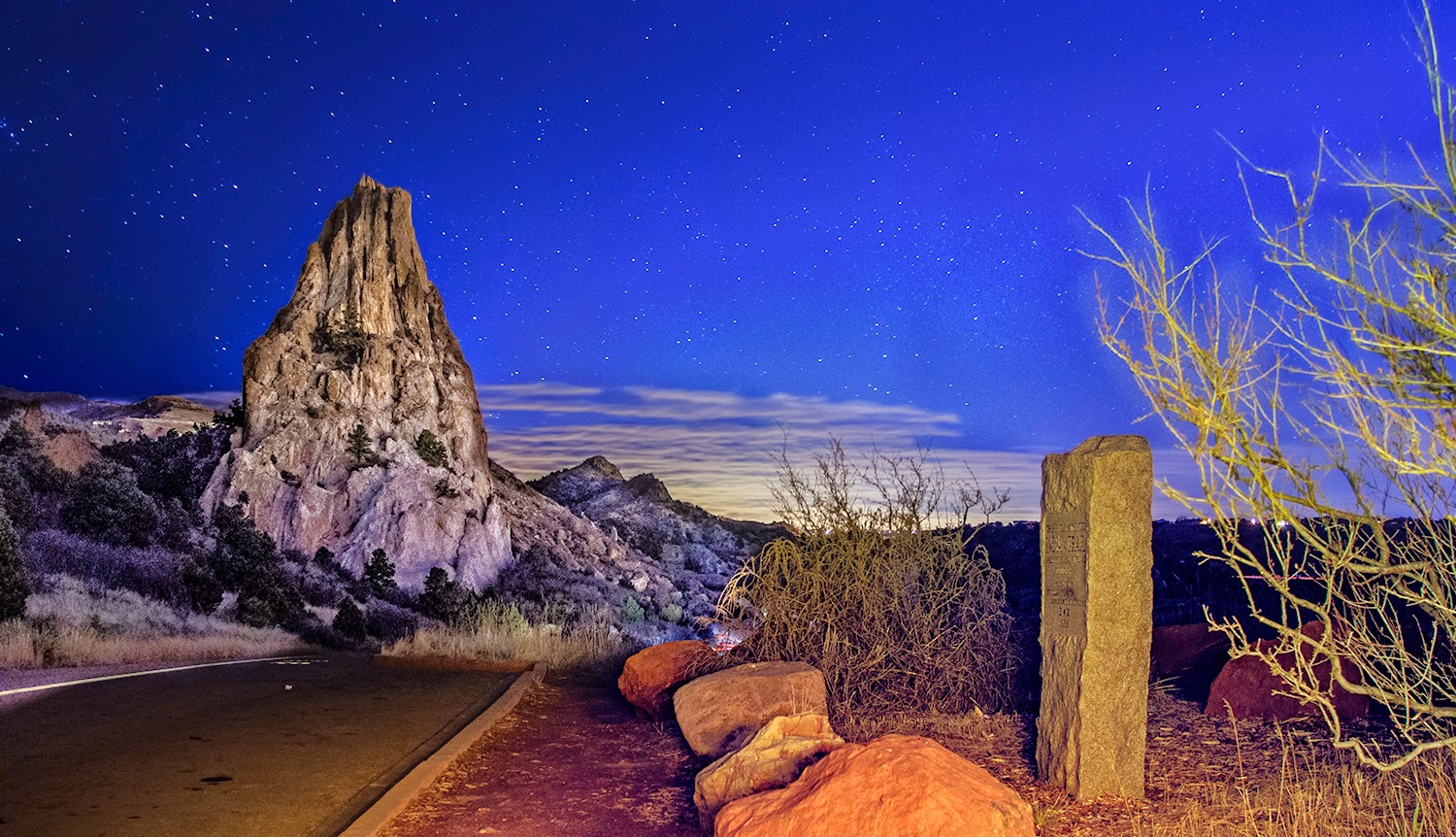
As part of a much larger project, I just got back from a visit to Garden of the Gods in Colorado Springs.  But I didn't go during the day - in fact, I went at 2:00 in the morning, trying to get the moonlight just right.  I wasn't altogether successful, as even a tiny sliver of Moon was too much.  Fortunately, I miscalculated how long the hike would take me, and I got to the hilltop before the Moon even came up.

But even before that happened, I took a shot on the roadway to the South of the main formations, looking North across the short side of one of them.  As someone else's car drove in the distance, I got this shot:


As you can see, even at 2 in the morning, there's a great deal of light coming from the city.  So much that it tends to block out most of the stars, as well as the ultimate goal of my shoot, the Milky Way.  Every bit of light you see is from the city, as the Moon hadn't yet come up.

Having gotten that shot, my next task was to hike to the secondary location to try to get the Milky Way behind the main formations.  Hiking with a bunch of camera gear and a 13 million candlepower lantern isn't all that easy, but I still made better time than I was hoping.  I got to my scouted location just before the Moon rose, and got this shot, which just happened to have an eagle-shaped cloud looking like it was ready to land on Pike's Peak:


The brightest light, just above the eagle's wing, is Jupiter.  Right after this shot was taken, the Moon started to come up, and ruined what little darkness was present.  I hiked back down, never having used my huge lantern, and returned to the car to continue my journey to other locales that same night.

See you next time!

Wednesday, February 18, 2015

Shae and Jon


Shae had been attending BYU-Idaho online from her original home in Idaho, but had been convinced by her sister and brother-in-law to come down to Colorado.  Colorado has all the beauty and grandeur of Idaho, but throws in some civilization and sophistication to boot – what’s not to love?  Well, it turns out that being Assistant Manager at a chain restaurant may not have so much to love, but everyone has to start somewhere, right?

It wasn’t long before Shae had seamlessly integrated herself into the local Colorado Mormon community, and met a number of great people at a movie night being hosted by one of the church members.  Among those was Jon, a transplant from West Jordan, Utah.  They immediately hit it off as friends, spending time getting to know each other during more church activities before the unmistakable spark of romance was felt. 
For Thanksgiving, Jon and Shae went to her family home in Idaho, and then to his family home in Utah, where a plan was afoot.  During a walk through Temple Square to an intimate gazebo, Jon proposed to Shae, presenting her with a ring exactly like one she had looked at dreamingly while window shopping.

Fast forward just two months, and the wedding plans are being put together!  And Shea’s long since moved on from the restaurant job, in so many ways.


Based on the timeline we had available, I knew the timing for this shoot would be tight.  One of their favorite places is Daniels Park just South of Denver, with which I’m quite familiar, so no scouting was necessary.  We scheduled to go out right after her work day was over, but there was a slight delay when we needed to pick up crucial portions of one of her outfits.  

We arrived at the Park just before Golden Hour, so we still had time to catch the light, but there was no time to go over what we wanted to do – only time to start shooting.  Knowing that some variables might come into play, I had used the previous several days to plan out the shots we would need, so the session started right away. 

I brought my full-frame camera and a 50mm prime lens as my primary, and left my backup crop-frame and several other lenses, along with two tripods and two 800WS radio strobes and stands, in the car.  It would be a quick matter to go back and get them if needed, but none of it would weigh me down for what needed to be a fast-moving shoot.

And fast it was!  We breezed through six locations before noticing that the light was now quickly disappearing.  The Sun had just barely dipped below the horizon, giving us a perfect chance for some silhouettes before the color in the sky went away.  I ran back to the car to get my backup camera and a 24-120mm lens, as I wanted to get farther away from Shae and John, to allow for more zooming in on the horizon.  The rest of the shoot was spent switching between cameras to get different effects from the same poses.

Even Molli, Jon’s longhair Dachshund got involved, posing dutifully while being teased with bologna, and then resting quietly in John’s truck during the rest of the shoot.  All in all, we accomplished a great deal in a short period of time.  I never used my strobes, as the natural light was changing so quickly there was no time to get them set up, and they weren’t really necessary anyway with all the wonderful colors present during a Colorado sunset.

It’s a privilege to be a part of Shae and Jon’s world, and I’m so grateful that they chose me to help them remember one of the most significant turning points of their life together.  I wish them all the best in their journey.

Sunday, October 5, 2014

The 1968 Mustang GT500KR

Being arguably the most popular muscle car in history, most aficionados will know that there were many high-performance badges bestowed upon the Mustang throughout its tenure.  The more noticeable would be the Boss 302, Boss 429, GT350, and GT500.  But there were other enumerations as well, labels which wouldn't make it so much into the popular vernacular.  The GT350H is a good example, as it's more special than the GT350, but many people aren't that familiar with it.

Even more special than the GT350H is the Cobra GT500KR, a designation awarded only in 1968, though it was later resurrected in 2008 and 2009.  The marque was so well-regarded that it took Carroll Shelby returning to the Ford fold to bring it back.  During the decades that Ford destroyed the spirit of the Mustang, not even they dared call anything else a GT500KR than a real Shelby.

It was known as "The Ultimate Mustang," and the official literature claimed that the Cobra Jet 428 would put out 335 to 360 horsepower, but that was a ridiculous marketing ploy in order to be able to put a real racing engine into a production car. 

The real number was certainly over 400 horses, with the engine being a hotrodded version of the previous Police Interceptor, with large ports and better exhaust.  Ford was proud of its recent wins in 1966 and 1967 at Le Mans over Ferrari, and boasted with the term Cobra LeMans diecast into the valve covers.

Production was limited to 1,053 fastback GT500KRs, with only 530 being ordered as 4-speeds.  Special Yellow was a very uncommon color, with only 44 being order with the WT6066 paint code.  Only 10 had air conditioning.  And finally, only one was sent to the SouthWest.  This is that car, which has finally found its way into the hands of Brian Nielsen, and into our camera.

According to Autotraderclassics, the GT500KR is not only one of the most sought-after cars in history, it's so rare that most are trailer queens, living out their days in a hermetically sealed box, never feeling the wind on the open road.  Not so this car.  Brian does indeed drive it.  We were not lucky enough to get permission to drive it ourselves though, so Brian can remain safe in the rarified air of being one of only a handful of people in the world who have had the experience of driving this legend.

Special thanks go out to him for allowing us to shoot it, and for the rare times when he agrees to show it.  It's a wonderful example of the way we used to treat the experience of driving.


Tuesday, September 16, 2014

Chihuly at the Denver Botanic Gardens


This summer is seeing a quite deserved Renaissance at the Denver Botanic Gardens, with the addition of dozens of glassworks by Dale Chihuly among the voluminous plant, tree, and flower exhibits.  Over the past twenty years, the Gardens haven't expanded their space, but have tremendously expanded the variety and sheer numbers of plantings and exhibits.  The entire area is now filled with flora not only that is native to the arid Mountain Desert region, but also heavily populated with varieties that are native to other parts of the country, even other parts of the world.

One of the larger displays, in front of the Greenhouse.
So it's only fitting that they find a way to increase attendance, and having Dale Chihuly bring a portion of his collection over is certainly the way to do it.  Crowd sizes are staggering, bringing much-needed revenue to this facility.  Open until the end of November 2014, the best time to see the display is early morning.  By Noon or a little after, it's difficult to walk around the park, much less try to get undistrubed time looking at what's on offer.


Chihuly has many styles of glasswork, and a subset of them is represented here.  The most prominent are glass spires of red, blue or yellow, strewn about native grasses like tall reeds.  But the more interesting displays are when those grandiose installations are eschewed in favor of something a bit more subtle, if subtlety is even possible in a show like this.

Globes, fingers and spires of purple and blue trail out of a small boat.


http://www.smugmug.com/gallery/n-nLnxW/The show is also open at night (under separate ticket prices), where some of the glass is lit externally, and some internally through neon lighting.


This installation in front of a waterfall is reminiscent of Chihuly's work on the ceiling at the Bellagio in Las Vegas, though of course that's only a small fraction of what's on display.


Come down and see it before it's gone - it's a popular traveling show, so it may never come back!

Sunday, August 17, 2014

Arvada Vitality Alliance Benefit

I was invited several weeks ago, to be a part of a fundraiser for a relatively new organization, the Arvada Vitality Alliance, or AVA for short.  The AVA is dedicated to the furtherance of public art displays in Arvada Colorado.  My first thought was "why would something like this be necessary?"  I was certain that more than enough public funding would be available for any art installations around the city, much like so many other cities across the Front Range.  But it turns out that's really not the case.

Public art is woefully underfunded in Colorado, as it has been for many decades.  No matter which party is in power, expenditures for what are seen as frivolities either don't make it through the political process at all, or when they do, the funding has been severely restricted.  This is short sighted for a couple of reasons.

First, public art creates an identity for the area.  One has only to look at Paris, Egypt, New York, St. Louis, or a hundred other cities whose identities are forged specifically by their public art installations.  I'm not talking about museums.  The pieces you have in mind when thinking of these cities are giant, imposing, memorable artworks that will remain in your mind for the rest of your life.  And when you do think of those pieces, you'll invariably think of the cities they live in.  Having your home city spring into people's minds as they move through their lives is not only good for tourism, it's good for the cultural legacy of the city in general, helping ensure that successive generations stick around to continue the work their parents started.

Second is the return on investment, or ROI.  The City of San Diego for example, found that in fiscal year 2011, for their $7 million investment in public arts, there was a resulting income increase of $170 million in outside spending, with two million visitors arriving specifically as a result of the Arts.  It also found that 6,000 jobs were created as a result, and that out-of-town visitors who came for Arts events stayed an average of two days longer than the typical tourist, and spent twice as much.

This is pretty serious money, though blogger Smart City Memphis would disagree.  SCM believes that talking about investment return shouldn't be on the table when Conservatives are in power.  I can't imagine why that would be the case, and SCM doesn't offer any alternatives.  Just that ROI shouldn't be brought up.  To the contrary, ROI is precisely what Conservatives are begging to hear about.  In a Governmental context, they don't care about aesthetics.  Conservative dogma doesn't allow for that.  It only responds to specific reasoning, which proponents of public funding (most often Liberals) have historically been weak at presenting.  The public benefit of a public project needs to have a specific reason to be funded.  Fortunately, Public Arts has all the firepower needed for such a discussion.  Please be clear:  I'm not attempting to create a split between Conservatives and Liberals, nor am I trying to promote one agenda over the other.  Rather, I'm attempting to bring the two sides together for a common goal.

Barring the public funding aspect of the Arts, private donations are often brought in to supplement.  The AVA exists for precisely that reason.  Friday's event was a gala get-together and art auction presented in the Lamar Street Center space, often called Steel Affairs.  This event, like most others at Lamar, had an automotive theme, showing off the cars of board members, active community members, and Larry Winkler, owner of of the center.  The event was a great success, resulting in art sales, donations, and a wonderful time had by all who attended.  Some of the rarest cars in the world were there to see, and attendees wove around them during the night.

One facet of Conservative mindset would be that this is the way to fund all public art - by private donation.  This mindset may exist because it's believed that the donors somehow reap the benefits of their donation by getting something back in the form of ROI.  They don't.  They're donating because they believe in the cause, and for that reason alone, since they receive literally nothing back for their money.  They're so sold on the concept of public art that they're willing to give their money away with no chance of profit, rather than see less public art installed.

They're stepping in, at their own expense, to try to supplement inadequate funding for something that benefits us all.  True Conservatives and true Liberals alike know that the benefits of public Arts funding are tangible, and necessary for a thriving society.  Let's all work together to achieve a goal that brings us all so many benefits.

My thanks go out to Ereka O'Hara for having me be a part of it.  I hope to see you all there next year!

Tuesday, July 29, 2014

Failure is Inevitable in Landscape Photography

There will be no sample pics in the post, because there aren't any to be had.

We've all done our best to deal with failure, and it certainly is frustrating.  But to be able to keep going, every photographer must understand that failing is not just part of the job, it's most of the job, particularly with something as fickle as nature.  Nature doesn't care about our timetable, and isn't remotely interested in whether we're present or not, prepared or not, or what our expectations are.  A human being trying to figure out when the best shot will present itself is the very definition of hubris.  The fact that we as photographers try to adapt to a virtually unknown and unknowable schedule leads to a lot of wasted shots and wasted time.  But there simply is no other way, and getting used to it will make your life better.

This week I've been researching a specific shot that was requested by a client, to replace a landscape photograph in their home that's about 140 years old.  She would like to have the same view, but taken today.  It shouldn't be surprising that very little information about certain areas remains after that length of time, so it's been difficult not only finding out the photographer, but exactly where the shot was taken.  The area is now quite built up, so it may end up being impossible to see the natural features that are so prominent in the original photograph.  After using Google Earth to find some location candidates, I scheduled a trip to the area, which is in Southern Colorado.

The trip took a day, covering over 400 miles, and had to be scheduled so that I would be there late in the day.  That's the only time the sun is in the right spot to illuminate the mountain peak, as it faces Northwest.  Summer is also the only time the sun pulls far enough North that the right light could be achieved, and the weather needs to be taken into consideration as well.  There should be some light, puffy clouds, but not enough to shade the mountain.

Weather.com and Weather Underground are my sources for forecasts, and I was assured by both, as late as an hour before I left, that there was zero percent chance of rain, and 7 percent cloud cover.  Looked perfect.  By the time I got within thirty miles of my destination, I could tell I was wasting my time.  There was a huge wall of gray blocking the mountain and the town, but nothing anywhere else - just 95 degrees and blue sky on the entire trip so far.  Within ten miles of the mountain, I started to see lightning on all sides, and another bank of storms lining up behind the current deluge. This wouldn't be an "interesting" storm that would play with the light and make for a once-in-a-lifetime shot.  This was an all-encompassing wall of despair and wetness that would render all shadows and highlights moot, blanketing the entire area in complete shadow.  I had come this far though, so there was no point in pouting about it.  I continued on.

Through the rain, I found the two candidate spots, and could tell right away that they weren't the right locations.  One of them didn't even afford a view of the peak, a small rise being the culprit.  So at least I had gathered a little knowledge for my time.  There was another majestic view of the peak with the town laid out below, which I knew in advance was not the right location, but I went up there anyway, since I had come this far.  This view over the town was available by virtue of a high bluff, which just happened to have a huge sign and flagpole atop it.  Even though it was raining and there was lightning everywhere, I went up the dirt road anyway, risking my life for a shot I couldn't take.

Knowing that it wasn't worth getting the regular camera out, I pulled out my point-and-shoot and grabbed a snapshot of the almost-black mountain overlooking the town.  As the rain picked up even more, another car pulled up as I was leaving, with a family.  I briefly noted to myself how stupid they were for coming up there during a lightning storm, but soon remembered my own idiocy, wished them well in my mind, and drove off.

So nine hours wasted so far, with nothing to show for it.  But this was only one failed attempt.  There may be several more before I get what I want for this shot, and every other photographer has been through the same thing many, many times.  So don't get discouraged.  You'll need to wait all day, fail, and then come back another day, or perhaps hike to one spot four times to get a shot like the great Wally Pacholka, or wait until the right time of year, only to miss out yet again.  Keep going.  It's not your failure, it simply a part of the process required.  Be warned though, that after all that work, people will be even more likely to say it's a fake!

Friday, July 25, 2014

Anatomy of a Motorcyle Shoot - Part 1

Many readers of this blog photograph cars as either their hobby or their trade.  Shooting a motorcycle presents its own challenges though, so let's branch off the beaten path for a bit.  We'll see how you can get wonderful shots with only a minimum of equipment, a fair amount of attention to detail and technique, a lot of time setting up, and a lot of time in postproduction.

The Circumstances


The bike in question is a 1952 Vincent Red and Black known as Hellboy, one of the finest bikes in the world, and certainly the finest of the 17 of these beauties ever built.  Now that this bike has been shown, it's safe to put it up in this post.  Its only show so far has been Keeneland Councours in Lexington KY, where it earned Best of Show.  It's owned by Gene Brown, almost certainly the winningest collector the U.S. has ever seen.  At this year's Quail Motorcycle Gathering alone, he was awarded Best of Show, First Place, and The Design and Style Award.  He also won Best of Show as well as Best of Class, British 1901-1940, at the 2013 Del Mar Celebration of the Motorcycle with his 1932 Vincent, which I also had the pleasure of shooting last year.  Gene travels a lot, and as such, when he gets home, he's not too keen on packing everything up to go somewhere just for a shoot.  So believe me, when Gene calls, wanting you to come over to his place for a shoot, it's time for you to make it happen the way he wants it.

So instead of going for a location or a studio, I needed to pack up the essentials and do the shoot in his quite nondescript and unassuming garage.  Since I needed to control reflections and lighting, we needed to make sure there was little sunlight, so we got started at 7:00 P.M. 

What I Took


I'm a firm believer that all of the tools that I use are important to me, but not to my client, and probably not to you in most cases.  Would you care what type of pencil your architect used?  Or how many hammers your carpenter had?  Certainly not, because how well either of them do their job is not defined by brand.  It's defined by the proper tool and the proper expertise only.  It's important that you have a hammer in your construction job.  What's not important is how many hammers you have, or what brand they are (usually).  So with that in mind, I'm sure the keen eye can tell what brand and model of seven-year old camera I use by looking at the first setup shot in the second part of this series.  But I invite you to not care about that, and instead focus on technique and which tools get used in which circumstance.  If you obsess over getting the latest camera every six months to make your shots better, this article is going to upset you, and you don't need that.

Camera


Okay, so the camera is an obvious choice.  We'll definitely need that.  I brought just one lens, and not even a prime.  The surroundings of the garage will dictate how far away I get, and unless I have a set of six or eight primes, I probably won't have the right one for this distance anyway.  My only non-special-effect primes are a 35mm and a 50mm, and I can't remember the last time I used them.  As far as the rest of the actual camera gear, I brought a tripod, a geared head, and a radio remote trigger, so I don't have to touch the camera.  And that's it.

You could get by with a ball head, but that makes it harder to make fine adjustments in shot alignment.  Having said that, I've done plenty of shoots that way before, and no one was the wiser, except for me.  You bring (and buy) the tools that YOU think will make your job easier.  So which brand of geared head?  Well, you could spend hours perusing photography forums and experimenting with rentals for months like some people do, or you could go an actual camera shop and actually try one or two for yourself, and then buy one and move on with your life.  I use a Bogen/Manfrotto 410, which is an awesome head, but mine was bought used, and has a bent gear, so one of the axes is very difficult to turn.  And yet, I use it anyway, because I have learned to work within my gear's limitations, instead of always buying new stuff.  The client doesn't know and doesn't care whether the gear is bent, and I don't obsess over getting new heads.  It doesn't slow me down in any appreciable way.

Lighting


No strobes.  We don't want hot spots on the bike, since one of the uses will be for website promotion, and possibly builder promotion.  They're looking for shots that will show off the bike, not the reflection of an umbrella in the gas tank.  Any softbox less than five feet high will be too small for this shoot.

I ended up bringing a 10'X30' white sheet for backdrop, stands, crossbar and clamps for that sheet, several pieces of whiteboard for reflection, and a large softbox with a rolling stand.  While most people use strobes inside these boxes,I don't need to do that, since I'm not working with human models most of the time.  An easier setup for me is to use it as one big light, lighting the entire area to be photographed, rather than as a high-key background.  To light it continuously I've built an LED lightbar that uses a 12V battery, and mounts on the rolling stand, inside the box.  That way I don't have to depend on location power, and I don't have to buy expensive battery strobes.

Custom LED lightbar, 12V

Closeup of one portion of lightbar.  Interested in plans?  Let me know.

The wheeled stand is a necessity, so that I can position it at will, changing angles and height if necessary. I use a Fotodiox box for this, because it comes standard with a great stand, and because their people are much more friendly and helpful than the people at Lastolite.  I've owned a Lastolite for several years, and I've noticed that it has not only yellowed over time, but its internal spring frame has also begun to sag, so that it can't stand up on its own.  Since I didn't buy it with a frame, I contacted Lastolite to see if a rolling frame was available, and to see if there was something I could do about the internal frame.  I received no response whatsoever.  The Lastolite now sits in my studio, never to be used again.  So this is one of those rare times when I'll encourage you, dear reader, to use one brand over another, simply because of my own experience.  You're welcome to use whatever brand works for you.

Fotodiox has not paid me or given me anything at any discount. 
Their great customer service earned them this very rare plug.


Wait, so that's it for gear?  A camera, a lens, some sheets and a custom light?  Yes, that's all I need, and everything works out just fine.  If I had the luxury of bringing the bike to an all-white 60X40X20 studio with a Cyclorama and hanging lighting, the shoot (and postproduction) may have gone faster, but since I roll at the whim of my clients rather than the other way around, having such a studio would be, ultimately, an immense waste of money.

I also brought a large amount of spare gear in case something went wrong.  But since nothing did, it doesn't seem relevant to this article to mention what spares I had.  Bring spares for the unforeseen, for you will indeed see it one day.  Even if you don't have the money for a spare body, you'd better be bringing some kind of camera to use if you drop your only body*.  If you get caught because you broke something you only own one of, come up with a different way of shooting on the spot.  That's part of your job.  One very important note, though:  DO NOT tell your client about your problem, or it will be held over you forever, even though there's nothing whatsoever wrong with the outcome.  Their impression will be enough to pollute the result.  Don't even tell them you had to bring out your spare camera body.  They will ALWAYS think there's something inferior about what you present to them.  This was a hard-earned lesson for me many years ago, and I've not forgotten it.  You can read about this lesson in my previous post, Why You Shouldn't Tell Your Clients About Your Mistakes.

* - Some people will tell you that you're required to own two of everything, so you can always have spares.  But no matter what your budget is, there will always be something you only have one of.    Don't be intimidated by Internet know-it-alls (including me) telling you how inferior your gear and budget are.  If you have a camera and skill, you'll be just fine.

Next up: Part 2 for the shoot itself.